「関西の陶芸展 亀井洋一郎展」藤 慶之,陶説,日本陶磁協会,2006年12月号
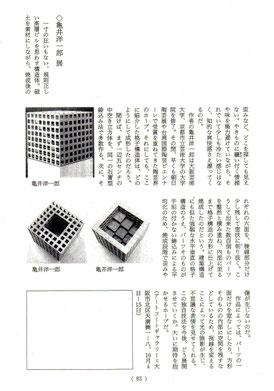
一寸の狂いもない、規則正しい高層ビルを思わす構造体。磁器土を素材にしながら、焼成後のゆがみなど、どこを探しても見えない。やきものにまとい付く情緒や味を極力避けていながら、それでいて少しも冷たい感じはなく、知的な爽快感さえ漂ってくるのだ。
作者の亀井洋一郎は大阪芸術大学、京都市立芸術大学の大学院を修了。その間、早くも朝日陶芸展や台湾国際陶芸ビエンナーレで受賞を重ねてきた陶芸界のホープ。それにしても、このような格子構造体は、どのようにして成形したのだろう。聞けば、まず一辺5センチの中空き立方体を、同一の石膏型鋳込み技法で多数作る。次に、それぞれ6面を、稜線部分だけ少し残して窓枠にくり抜く。こうして出来た数百個ものパーツを整然と積み重ね、内部に至るまで格子構造体の方形に仕上げて焼成したのだという。建築構造にも似た強靭な水平垂直の格子構造のうえ、パーツそのものが手あとの付かない鋳込みによる平均化のため、焼成段階での歪みや傷が生じないのだ。
作品によっては、パーツの一面だけを窓なしにしたり、方形そのものの内部に空間を残すなどしているため、視線を変えることによって光の陰影が生じ、不思議な表情を見せてくれる。
この独自技法を今後、どう展開させていくか。大いに期待を抱かせるホープだ。
藤 慶之(美術評論家)
Yoichiro Kamei Exhibition
Lattice Receptacle(Art Court Gallery/2006)
With its exact symmetry and precision construction, the pale blue glazed porcelain work gives us the feel of a modern architecture. Even after enduring the extreme
temperatures of firing, the porcelain shows no distortion and despite measures taken to minimize emotion and aberrations, rather than coldness and impersonation, the object exudes a refreshing,
intelligent air.
Following his master's degrees at Osaka University of Arts and his doctorates from Kyoto City University of Arts, the artist Yoichiro Kamei soon went on to win the
Grand Prix at the Asahi Ceramic Art Exhibition (Japan) and the Merit Prize at the Taiwan International Ceramics Biennale (Taiwan). These and other recognitions have made him a rising hope in
ceramic world.
Having said that, his lattice construction techniques are truly intriguing. Yoichiro Kamei explain that he makes a 5cm x 5cm hollow cubic by slip casting with
plaster form first. And then he proceeds to cut away as much of the unnecessary material as possible, leaving only a slight frame. He repeats this exercise and ultimately builds his masterpieces
with hundreds of these squares combined systematically. A lattice construction results in extremely structures and is used regularly in architecture. And through slip casting, each part is kept
identical and there is no distortion or cracking during the drying and firing stages.
Each work is unique and changing the viewing direction or angle affects the resulting lighting and shadows, creating a mood of mystery. We greatly look forward his
development of this technique and to his development as an artist. We are expecting great things from him in the future.
Yoshiyuki FUJI- art commentator