「思考を積む ‐亀井洋一郎の現在地‐」大長智広,LATTICE RECEPTACLE YOICHIRO KAMEI 2001–2017,作品集,2018年
「思考を積む -亀井洋一郎の現在地-」
大長智広(京都国立近代美術館研究員)
亀井洋一郎が《Lattice receptacle》で、栄えある朝日陶芸展のグランプリを獲得したのが2001年である。ここからすでに16年余りが経過した。この間、亀井は自らの制作上の課題を明確にしつつ少しずつ歩を進めてきた。亀井は《Lattice receptacle》シリーズを制作するに当たり、鋳込みで基本単位となる5cm立方のキューブを作り、面を切り取り、それを積み上げるという作業を行う。この積み上げられたキューブは、垂直、水平の力学に従うことで法則性を持つ幾何学形態へと変貌する。
とはいえ、やきものの仕事とは、水分を含む可塑性を持つ粘土を素材に成形し、乾燥、焼成を通じて水分を失わせると同時に粘土の組成そのものを変えることで、半永久性を持つ「陶」に変容させるものである。ちなみにセラミックスとは、無機物の焼結体のことをいう。このような媒体では、制作を行うにあたって重力や熱量、物質的特性などからは自由ではいられない。実際に亀井の《Lattice receptacle》シリーズでは高温焼成によって土が陶へと変わる過程で、土が動き、ゆがむ、たわむというやきもの固有の特性が巧みに造形に取りいれられている。つまり、重力とやきものの特性を利用することによって、積み上げられた個々のキューブは結合するとともに、はじめて作品における視覚的水平性、垂直性を獲得することができるのである。《Lattice receptacle》とも関連するために、ここで亀井の《Ceramics Drawing》についても触れておきたい。
この作品シリーズは、平面的であることも含めて、一見すると亀井の従来の仕事とは大きく異なっている。制作方法は、作者が設定した一定の秩序に従ってセラミックファイバー紙にセラミック顔料や酸化金属でドローイングを描き、それを板ガラスで挟み込んで焼成を行うというものである。焼成によりドローイングは様々に変化し、物質固有の特性を顕在化させる。高温焼成の過程では、亀井が設定した条件に対して、その条件内にとどまらない物質性とのせめぎあいが常に起こっている。時に亀井の想像を超える結果をもたらす物質的変容は、綿密なプランに従って制作される《Lattice receptacle》に基づく亀井の経験的枠組みに揺らぎをもたらし、「やきもの」という存在をあらためて理解していくためのきっかけとなった。
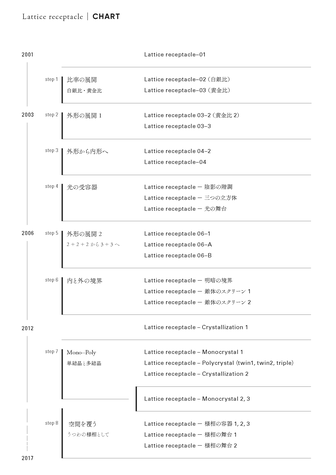
このように、やきものには素材の特性や重力、焼成との関係性からくる制作上の制約が多くあるが、亀井はそれを受け入れつつ、作者の意思を通じて「やきもの」として明確化させることを試みてきた作家である。この亀井の思考の軌跡をよく示すものに、自身の仕事の展開をまとめたチャートがある。そこには2001年の朝日陶芸展グランプリ作品を出発点に置き、STEP1から8までが記されている。その展開は順にSTEP1「比率の展開 白銀比・黄金比」、STEP2「外形の展開1」、STEP3「外形から内形へ」、STEP4「光の受容器」、STEP5「外形の展開2 2+2+2から3+3へ」、STEP6「内と外の境界」、STEP7「Mono-Poly 単結晶と多結晶」、STEP8「空間を覆う うつわの様相として」となっている。ここではキューブを積み上げるという手法は全てに共通しながらも、思考の深化がもたらす作品の変化が論理的に展開している。こうした亀井の作品展開は、各STEPでの仮定と考察、実制作を経て生じた新たな課題をやきものの造形として次にどのように解決していくのかの道筋を示したものであり、その根底には、「うつわとオブジェという表現形式の隔たりを私はどのように共存させ得るのか」という問題意識が存在する。
今日、私たちはオブジェと器物を区分することについて、ほとんど疑問を持てないほどにその区分は一般化している。これは主要な各種公募展において、多くの場合、「自由造形」と「伝統」とに対象が分けられていることからもわかる。確かに日本のやきものは、伝統工芸、伝統技術という価値観を確立させたことで、今日まで連綿と守り伝えられてきた。加えて、それが展覧会や人間国宝の制度に置き換えられることで、伝統的な陶芸家であっても、美術家・芸術家としての世間的評価と地位を獲得することが可能になった。一方で、この問題は、一見制度に反するかのように登場したオブジェにおいても当てはまる。日本で陶のオブジェが登場したのは戦後のことだが、走泥社のリーダー的存在であった八木一夫が述べているように、オブジェの先駆的団体である四耕会の活動は、連綿と守り伝えられてきた「やきものの魅力」の外にあるとして、驚きを与えつつもその表現行為が陶芸界から等閑視されてきた。この状況を横目に見ることで、八木ら走泥社の作家は、陶芸家が心情的に抱え込む「轆轤」や「土の生理」などのキーワードを通じて陶芸としての「正当性」を導き出し、やきものという制度に沿って自身の活動を展開させていったということもできる。その意味で、走泥社の「壺の口を閉じるとオブジェになった」という言葉並びに思考法は示唆的である。
亀井が活躍する現在は、四耕会や走泥社の作家がオブジェを制作し始めた時期から60年以上が経過し、また、現代美術に近接したとされるクレイワークの1980年代を経て、美術や陶芸を取り巻く状況が大きく変化したかにみえる。しかし、我々は表面上の表現の多様化に対して、器とオブジェを区分する態度や、両者の関係について思考停止に陥らせてしまう「やきものの魅力」による潜在的な束縛からは未だ自由になれてはいない。それに対して亀井は、両者の通念上の表現形式の隔たりの存在を認めたうえで、やきものとして両者を「共存」させることの可能性を、倫理性を持った造形において追求している。これは焼成を必要とするやきものは必然的に内部に空洞をはらむことから、すべて「器」であると断定するような近年の安易な造形思考によるものではない。それが亀井の制作を、かつて走泥社の作家たちが試みたように「壺の口を閉じ」てオブジェとする態度ではなく、いかに「口をあける」のかという意識から出発させるのである。
口をあける。これだけを聞くと、あらためて壺や皿など我々に馴染み深いやきものの姿が思い浮かぶかもしれない。しかし、格子状の亀井の《Lattice receptacle》シリーズは、一般的なやきものに対する器物からは程遠い。またそれはいわゆる従来型の陶のオブジェとも異なる形態感覚を有している。人は「はじめて」の物事に出会った時、自らの記憶の奥底を探り、その中から類似点や共通する何かを見つけることで、目の前の物事を把握し理解する。そのために対象の認識においては、自らの経験や立ち位置に多くを負うことになる。そして亀井の作品の格子状の形態は、表面的な類似性から、多くの場合で「ビルのような」、「ジャングルジムのような」と形容されてきた。ただし、この形容詞は亀井作品の形態の特異性(オブジェ的性格)を際立たせるとしても、それだけで認識を完結させてしまうことから、形態を通じた器物性へと思考を向かわせることはほとんどないように思われる。しかし器の造形をその一般的な形態的特徴から、ひとまず、ある空間が面によって覆われていったもの、そして開口部を軸に内部と外部を緩やかにつなげる役割を持つものと捉えると、造形性と器物性の関係を考える手がかりが見えてくる。
私は以前、亀井の作品が自然界のものごととの構造的共通性を持つことを指摘した。(『美術の窓』2016年6月号)それは、基本単位となるキューブを積み重ねた亀井の作品同様に、自然界ではほとんどのものが結合体として存在する事実にイメージを重ねてのことである。例えば雪などの多結晶は単結晶の規則的配列が導く複雑で美的な結合であり、同様のことは蜂の巣のハニカム構造においてもいえる。特にハニカム構造は、単純なユニットを一単位として、それを規則的に増幅させていくことで、密度と強度、容積、さらに美性をも獲得している。自然界にはこのような幾何学的デザイン構造を持つものが多く存在しており、その造形性は、偶然にも結晶をテーマとした後の亀井の作品に近似する場合がある。そこで自然界の生物それ自体に目を向けてみる。生物は動物と植物とに大きく分けられるが、いずれも細胞の結合によってその形態が成立している。これは原子や分子の規則正しく周期的な配列で構成された固体という意味での結晶そのものではないが、生命活動に基づく規則的、必然的な結合体の一つの理想的な姿である。しかし動物と植物との根本的な違いは、その構造にある。
哺乳類のような動物は、食物の捕獲など生命維持のために移動を伴うことから骨格系を持ち、その骨格系に支えられて細胞が結合している。そのために細胞の結合体は重力の影響(力学的条件)から自由となる反面、骨格系という制約があるために、大きさや形の自由を獲得することはできない。一方の植物は生命維持に移動を伴う必要がないことから骨格系を持っておらず、自身を支える構造を自ら構築する必要がある。そこで植物は、細胞を内部に核と液胞を抱え込んだ硬い細胞壁に覆われた形とすることで、レンガ建築の様に細胞を積み上げることを可能とし、大小様々な形態を作り上げてきたのである。この構造であれば、重力と細胞壁の強度との関係、さらには自然環境などの自身の生存条件との関係において、必要に応じていくらでも成長、増幅を繰り返すことができる。しかも細胞個々が形態の生成と維持に直接的に関与することから、原理上は一つが欠けると構造が維持できずに崩れてしまうように、一つとして不必要の細胞は存在しないことになる。加えて興味深いのは、植物では、細胞壁に覆われた形態内部に水や養分を隅々にまでいきわたらせるための管が張り巡らされていることである。管があることで構造的に中空となるが、この中空は造形から導かれるものであると同時に、実際に生命維持と直接に関わる用途性を有してもいるのである。
亀井の作品は5cm立方のキューブを基本単位として、制作プランにしたがって各部位の面を切り取り、縦横に結合させた格子構造である。面を切り取るということは、単に視覚的な変化をもたらすということではない。面が切り取られることで、そこに縦横無尽の通路が生じ、光や空気など様々な可視的、不可視的物質が自由に通過、移動できるようになる。さらに切り取られた面が連続することによって見るものの視線は内部の構造へと誘われ、その視線が、空間が生み出す造形性とその空間内外を通過、移動する光や空気がもたらす様々な変化の場に意味をもたらすのである。亀井はかつて自身の作品を「光の受容器」と称したが、ここでは器物であること、そして用途性を有することの意味が、造形における自律と他律の両側面から考察されている。ここに亀井の作品と生物との共通性があらためて見えてくる。それは亀井のキューブは、植物にとっての細胞個々の役割を担うものであるとともに、それらの結合体は、生命活動を営む植物の構造とも相似形を成しているということである。このように亀井は仕事を通じて、はからずも自然界の構造の神秘に触れる地点に立ったといえるが、それはそのまま陶としての根源的な世界への道筋にもつながっている。おそらくやきものにおける自然性とは、自然素材を使うことや、素材感に酔いしれること、作家の手を離れる焼成によって「魅力」が増加するということではない。今後、亀井の作品がどのように変化していくのかはわからない。しかし、その仕事は、「やきもの」という存在を理解するための、我々にとっての現代の「窓」であり続けるであろう。
Accumulating Thoughts:The Current Position of Yoichiro Kamei
Tomohiro Daicho
Curator, The National Museum of Modern Art, Kyoto
Yoichiro Kamei was awarded the Grand Prix of the splendid Asahi Ceramic Exhibition in 2001 for his work, “Lattice receptacle”. Since then, more than 16 years have already passed. During that time, Kamei has taken small steps forward while clarifying issues concerning his works. With Kamei’s “Lattice receptacle” series, he makes five centimeter-squared cubes by cast molding and carves out some walls, and piles the pieces up into artworks. These built up cubes are transformed into geometric shapes following the laws of vertical and horizontal mechanics.
Nonetheless, ceramics is about the act of forming the plasticity of clay, including the water it contains, drying it, and, through firing, changing the very composition of the clay while removing water to make something with semi-permanence, something called “pottery”. By the way, ceramics is the sintered body of inorganic material. In this medium, processes are not free from the laws of gravity, heat values, and material properties. In actuality, with Kamei’s “Lattice receptacle,” by firing the clay at high temperature, the moving, bending, and warping of clay as it turns into ceramic has been masterfully controlled and shaped. In other words, by using the properties of gravity and ceramics and combining these individual cubes, we can finally see the verticality and horizontality in the work. Here, I would like to also touch on Kamei’s “Ceramics Drawing,” as it relates to “Lattice receptacle”.
This artwork series, as it is two-dimensional, at first appears greatly different than Kamei’s main work. The process involves the artist adding ceramic pigment or drawing by oxidized metal to a sheet of ceramic fiber, following a fixed method. This is then sandwiched between sheets of glass and fired. Through the firing process, various changes occur in the drawing, and the properties of the material are actualized. With high temperature firing, a continuously changing materiality and conflict are constantly occurring beyond Kamei’s set parameters. At times, the results of material change go beyond what Kamei himself imagines, and, based on “Lattice receptacle” which follows a detailed scheme, it brings about instability in this experiential framework and becomes an opportunity to understand the existence of “ceramics”.
In this way, while there are many restrictions in the creative process, such as the relationship between material properties, gravity, and firing, Kamei has managed to accept them; he is an artist that who has experimented in clarifying what “ceramics” is through his intentions. To show the lineage of his ideas, there is a chart made by the artist himself that summarizes the development of his work. There are eight steps in total, using the 2001 Asahi Ceramic Exhibition as the starting point. The order of his development is as follows: Step 1 “Development of Ratio: Silver and Gold,” Step 2 “Development of Outer Form 1,” Step 3 “From Outer Form to Inner Form,” Step 4 “Receptor of Light,” Step 5 “Development of Outer Form 2: From 2+2+2 to 3+3,” Step 6 “Inner and Outer Boundaries,” Step 7 “Mono-Poly: Mono- vs. Poly-crystal,” and STEP 8 “Concealing Space: As Aspect of Vessel.” The fact that the assembling of cubes is a common thread means that the changes in the works have gone through logical development as a result of a deepening of thought. In this way, in the development of Kamei’s work, with each step there is an assumption and investigation, and it shows that with new issues born through the realization of works, Kamei takes a path to resolve them through ceramic shape in his next projects. The foundation of this is the awareness of the issue: “How can I resolve the gap in form representation between ceramic vessels and three-dimensional objects?”
Nowadays, the distinction between vessel and three-dimensional object is so taken for granted that it is not even an issue for us. We can see this from the fact that at various open call exhibitions, many times the categories for accepted works are divided into “free form” or “traditional.” No doubt, Japanese pottery was established through the value system of traditional crafts and traditional techniques, and this has continued unbroken until today. On top of that, when those values are expressed in exhibitions or with the Living National Treasure system, it is possible for one to acquire public status as an artist even though you’re a traditional potter. This even applies to three-dimensional objects, which seemingly goes against the system. In Japan, although three-dimensional objects appeared after WWII, as Sodeisha’s (an avant-garde ceramic art group established in 1948) leader Kazuo Yagi notes, the activities of the pioneering group for three-dimensional objects, Shikoukai, took the world by surprise but their act of expression was neglected by the pottery world, considered outside of the “attraction of ceramics that has been long preserved.” By taking a sidelong glance at these circumstances, Sodeisha’s artists such as Yagi derived the “legitimacy” of pottery through keywords such as the “pottery wheel” (an essential skill for potters) and the “physiology of clay,” which were sentimentally embraced by potters, and found out they could carry out their activities alongside the ceramic art system. In that way, alongside Sodeisha’s way of thinking, “Once you close the mouth of a vase, it became a three-dimensional object” is a way of thought pregnant with meaning.
Kamei is now active some 60 years after Shikoukai and Sodeisha began making their three-dimensional objects, and through the clay work period of the 1980s, adjacent to contemporary art, it seems as if great changes have taken place in the circumstances of art and ceramics. However, in regards to the diversification of superficial expression on the surface, there is no freedom from the latent restraint that stems from the attitude of separating vessels from three-dimensional objects and the “attraction of ceramics,” which stops critical thinking regarding their relationship. Kamei has recognized the gap between the expressive form of both of these accepted ideas and has pursued to find a possibility for their “co-existence” through a visual form that holds morality. This is not the easy belief of recent years that just because all ceramics need to be fired and that inevitably an inner hollow space appears, that everything is a “vessel”. This means that Kamei’s work doesn’t have the manner as that once Sodeisha artists tried to “close the mouth of the vase” to make a three-dimensional object, but more of how one can to be conscious to “open the mouth.”
Opening the mouth. Just by opening this, we probably remember typical pottery shapes such as vases and dishes. However, with Kamei ’s latticed “Lattice receptacle” series, this is quite a departure from vessels normally found in pottery. And they have a different sense of form to that of so-called existing three-dimensional objects. For humans, when we see something for the “first time,” we search our memory for something similar and when we find it, we can then understand what is before us. Because of that, when perceive something, often we rely on our own experience and position. The shapes of Kamei’s lattice works, from surface similarities, often are described as “building like,” or “ jungle gym-like.” However, even if these adjectives capture the uniqueness of Kamei’s works (three-dimensional object-like character), it concludes our perception at the same time, stopping our thoughts to consider its character as a vessel through its form. But from the special morphological characteristics of the vessel’s form, a certain space is covered by a surface, and when we capture how the line from the aperture gently connects the inner and outer that we are led to see the relationship between form and vessel.
In the past, I have pointed out how Kamei’s works structurally resemble things in nature. (Bijutsu no Mado, June, 2016) Similar to Kamei’s work where cubes of the same size are piled up, in the natural world too it is a fact that almost everything is made of units joined together. For example, clouds and other phenomenon have polycrystalline systematic structures that show an aesthetic union, and one can say the same for the structure of honeycombs in beehives. In particular, honeycombs take the same simple unit which are systematically multiplied. Not only do they acquire density, intensity, and volume but they also acquire beauty. In the natural world, there exist many things that have this geometrical design structure, and by coincidence Kamei’s later works also explore the theme of crystallization and have a close resemblance. Let’s take a look at creatures themselves in the natural world. Living things are mainly divided into animals and plants, but both are made up of a coupling and combination of cells. The fact that solid matter is made of a systematic and cyclic arrangement of atoms and molecules is itself not equal crystallization, but, based on biological activity, it is one kind of ideal example of a systematic and inevitable conjoined body. And the fundamental difference between plants and animals is their structures.
Mammals have skeletal systems to support movement vital to sustain life such as to capture food, and that skeletal body is supported by a combination of cells. While the joined body of cells are free from the in fluence of gravity (a condition of mechanics), due to the limitation of the skeletal system, mammals are not free to acquire shapes and size as they wish. As for plants, as they do not need to move to support themselves, they do not need skeletal systems, but instead need to construct a self-supporting structure. Plants are protected by solid cell walls made up of cells where the nucleus is wrapped in a vacuole, and as it is possible to pile up cells like a brick building, various sizes and shapes can be created. With such a structure, depending on the relationship between gravity and the cell wall, as well as the natural environment, plants can multiply repeatedly and grow as necessary as a condition for survival. However, concerning how individual cells create and support their own form, similar to the principle of when one element is missing the entire structure collapses, there is no such thing as an unnecessary cell. What is further interesting is that there is a tube system that brings water and nourishment inside of the cell wall in plants. The fact that there are tubes means there are hollow spaces and they are built inevitably due to its structure, but, at the same time, they are in fact directly connected to supporting life.
The structure of Kamei ’s works is made up of five-centimeter cubes, where some sides have been removed, piled up vertically and horizontally into a lattice structure. The fact that all sides of the cubes are removed is not just for a visual change. By removing one side, freely connecting spaces are born, and visible and invisible elements such as space and light can freely move and interact. And through these omitted continuous sides, our sight is drawn towards the inside structure, and we observe the molding born by that space, passing through the inner and outer spaces. This gives meaning to when the moving light and space creates various changes. In the past, Kamei himself has described his work as “receptors of light,” and, being a vessel with a practical function, this observation comes from both an autonomous and subordinated perspective in terms of form. Here we once again see a similarity between Kamei ’s work and living things. Kamei ’s cubes, while they have a role similar to individual cells in plants, their joined structure also is similar to the structure of biological activity in plants. In this way, Kamei seems to have unintentionally stood at the point of touching the mystery of structures in the natural world, and at the same time, that point leads to a path towards a primordial world of ceramics. Most probably, the natural element in ceramics does not come from the natural material, how the texture intoxicates artists, and how the works are released from the potter’s hands to be fired to gain “attraction.” I am unsure how Kamei’s work will develop from now, but his work and way of thinking will continue to act as a contemporary “window” for us to understand “ceramics.”